
Dog Feeding Schedule by Age: How Often Should You Feed Your Dog?
A dog feeding schedule should change as your dog grows. Young puppies generally need several small meals each day, while most adult dogs do well with two measured meals. Senior dogs may continue with two meals, although some benefit from smaller, more frequent meals depending on health and appetite. Breed, size, activity level, body condition, and medical needs should also influence the routine.
Dog Feeding Schedule by Age
Age is one of the most useful starting points when creating a dog meal schedule. Puppies have rapidly changing nutritional needs, while mature dogs generally need fewer meals.
Here’s a practical general guide:
| Dog’s Age | Typical Meals Per Day | General Feeding Approach |
|---|---|---|
| 6–12 weeks | 4 | Small, measured puppy meals |
| 3–6 months | 3 | Gradually reduce meal frequency |
| 6–12 months | 2 | Morning and evening meals |
| Over 12 months | 1–2 | Usually two meals for most dogs |
| Senior dogs | Usually 2 | Adjust according to health and appetite |
Puppy Feeding Schedule
Puppies don’t have the same feeding needs as adult dogs. They’re growing rapidly and have smaller stomachs, so dividing their daily food into several meals makes sense.
6–12 Weeks: About 4 Meals a Day
At this stage, puppies are growing quickly and generally benefit from frequent, small meals.
A simple schedule might look like:
- 7:00 a.m. — Breakfast
- 11:00 a.m. — Second meal
- 3:00 p.m. — Third meal
- 7:00 p.m. — Dinner
The total amount of food for the day should be divided among these meals rather than adding extra food at every feeding.
Puppy food should be formulated to support growth. Merck recommends complete and balanced diets appropriate for growth, with large- and giant-breed puppies receiving diets specifically formulated for their growth requirements.
3–6 Months: About 3 Meals a Day
As puppies grow, their stomach capacity increases and their feeding frequency can usually decrease.
A typical routine might be:
- 7:00 a.m. — Breakfast
- 1:00 p.m. — Lunch
- 7:00 p.m. — Dinner
Not every puppy will transition at exactly the same age. Appetite, growth rate, breed, size, and body condition all matter.
6–12 Months: About 2 Meals a Day
Many puppies can move to two meals a day during this stage.
For example:
- 7:00 a.m. — Breakfast
- 6:00–7:00 p.m. — Dinner
Some small breeds may need a different schedule, particularly if they struggle to maintain blood glucose or have difficulty eating enough in larger meals. Toy puppies can be especially vulnerable to hypoglycemia, so their feeding schedule may need to be more frequent.
Adult Dog Feeding Schedule
Once a dog reaches adulthood, most dogs can maintain a simple twice-daily routine.
A common adult dog feeding schedule is:
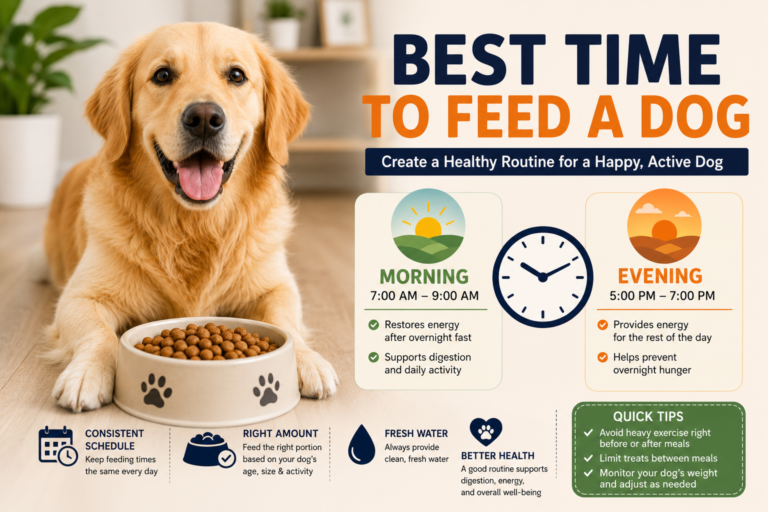
Morning: 7–9 a.m.
Evening: 5–7 p.m.
The exact dog feeding times aren’t important as long as they’re practical and reasonably consistent.
Merck notes that portion-controlled feeding with two premeasured meals at regular times is a useful approach for most adult dogs, particularly for managing body weight.
Why Feed Adult Dogs Twice a Day?
Splitting the daily food allowance into two meals can:
- Make portions easier to control
- Create a predictable routine
- Help prevent one very large meal
- Make it easier to monitor appetite
- Fit naturally around most household schedules
Some dogs may require a different frequency. A veterinarian may recommend more frequent meals for certain medical or digestive conditions.
Senior Dog Feeding Schedule
There isn’t one universal feeding schedule for senior dogs.
Many older dogs can continue eating twice daily. However, aging can bring changes in appetite, digestion, dental health, activity level, weight, and medical needs.
For example, a senior dog that struggles with large meals may do better with smaller portions divided into more frequent feedings.
Older dogs may also require fewer calories if their activity level decreases. The goal isn’t simply to feed less because a dog is old; the diet and portions should help maintain an appropriate body condition.
If an older dog suddenly stops eating, loses weight, becomes unusually hungry, or develops digestive problems, veterinary advice is appropriate. Merck recommends more frequent veterinary checkups for senior dogs because age-related health problems become more common.
How Often Should I Feed My Dog?
For most dogs, the answer depends mainly on age, size, health, and individual needs.
A general guide is:
- Young puppies: 4 meals daily
- 3–6-month-old puppies: 3 meals daily
- 6–12-month-old puppies: 2 meals daily
- Adult dogs: usually 2 meals daily
- Senior dogs: usually 2 meals, with adjustments when needed
Rather than being strict guidelines, these figures represent starting points. Some dogs need a different schedule because of their breed, metabolism, medical condition or lifestyle.
How Many Times a Day Should a Dog Eat?
Most adult dogs are commonly fed twice a day, while puppies need more frequent meals because they’re growing and have smaller stomachs.
The difference between the frequency of meals and the amount of food consumed each day is essential.
For example, if your dog’s daily food allowance is 2 cups:
- 2 meals = 1 cup per meal
- 3 meals = about ⅔ cup per meal
- 4 meals = ½ cup per meal
The total daily amount shouldn’t automatically increase just because you increase the number of meals.
Best Feeding Schedule for Dogs
The best feeding schedule is one that provides appropriate nutrition while fitting your dog’s biological and lifestyle needs.
For a healthy adult dog, a simple routine could be:
7:30 a.m. — Breakfast
6:30 p.m. — Dinner
For a puppy, the schedule may look like:
7:00 a.m. — Meal 1
11:00 a.m. — Meal 2
3:00 p.m. — Meal 3
7:00 p.m. — Meal 4
As the puppy matures, meals can gradually be reduced.
Consistency is useful because dogs generally adapt well to predictable routines. Scheduled meals can also make it easier to monitor how much your dog eats.
How to Create a Dog Feeding Routine
Creating a feeding routine doesn’t need to be complicated.
1. Determine the Daily Food Amount
Start with the feeding guidance for your dog’s food and consider your dog’s age, weight, activity, and body condition.
2. Divide the Food Into Meals
Take the total daily amount and divide it according to the number of meals.
3. Choose Practical Dog Feeding Times
Pick times that you can maintain consistently.
For example:
- Breakfast: 7:30 a.m.
- Dinner: 6:30 p.m.
4. Measure Each Meal
Using a measuring cup or, even more precisely, a kitchen scale can help prevent accidental overfeeding.
5. Monitor Body Condition
Watch your dog’s weight, waistline, ribs, appetite, and overall condition.
If weight is consistently increasing or decreasing when it shouldn’t, the feeding plan may need adjustment.
6. Count Treats
Treats aren’t nutritionally “free.” Merck recommends keeping treats below 10% of total daily calories to help maintain nutritional balance.
Does Breed Affect a Dog Feeding Schedule?
Yes. Breed and adult size can influence both nutritional needs and feeding frequency.
When Should You Talk to a Veterinarian?
A standard dog feeding schedule may not be appropriate for every dog.
Ask your veterinarian for guidance if your dog:
- Has diabetes or another chronic illness
- Is significantly underweight or overweight
- Suddenly loses or gains weight
- Frequently vomits after eating
- Has persistent diarrhea
- Refuses food
- Has difficulty chewing or swallowing
- Is pregnant or nursing
- Takes medication that affects appetite
- Is a very young toy-breed puppy
- Is a large or giant-breed puppy with specific growth requirements
A sudden change in eating habits can sometimes indicate an underlying health problem, so persistent or significant changes shouldn’t simply be blamed on a feeding schedule.
Frequently Asked Questions
How often should I feed my dog?
Most adult dogs do well with two meals per day. Puppies generally need more frequent meals: commonly four meals at 6-12 weeks, three meals from 3-6 months, and two meals from 6-12 months. Individual needs can vary.
What is the best feeding schedule for dogs?
For most healthy adult dogs, two measured meals at consistent times work well. Puppies generally need three or four smaller meals, depending on age and size.
What are good dog feeding times?
There isn’t one perfect clock time. A practical routine might be breakfast around 7-9 a.m. and dinner around 5-7 p.m. The important thing is consistency and appropriate daily portions.
Should I feed my dog once or twice a day?
Twice daily is a common recommendation for adult dogs. Some individual dogs may do well with once-daily feeding, but feeding frequency should take age, health, lifestyle, and veterinary advice into account.
Can I change my dog’s feeding schedule?
Yes, but gradual changes are often easier for the dog to adapt to. If you’re changing the schedule because of a medical condition, medication, or digestive problem, follow your veterinarian’s instructions.
Can I change my dog’s feeding schedule?
Yes, but gradual changes are often easier for the dog to adapt to. If you’re changing the schedule because of a medical condition, medication, or digestive problem, follow your veterinarian’s instructions.
Key Takeaways
- A puppy’s feeding frequency usually decreases as it gets older.
- Puppies from about 6–12 weeks commonly need four meals a day.
- Puppies around 3–6 months generally need three meals a day.
- Puppies around 6–12 months generally transition to two meals a day.
- Most adult dogs do well with two measured meals daily.
- Large and giant breeds may require special feeding practices.
- Toy-breed puppies may need more frequent meals because of their small size and risk of low blood sugar.
- A consistent dog feeding routine can make portion control and housetraining easier.
- The amount of food matters just as much as feeding frequency.
- Medical conditions, pregnancy, medications, and unusual activity levels may require a veterinarian-designed schedule.
Final Thoughts
A suitable dog feeding schedule by age provides puppies with frequent meals during early growth and gradually transitions them to a consistent twice-daily routine as they mature. Following an age-appropriate feeding schedule can help support healthy growth, weight management, and overall well-bein