
Introduction: Front-Clip vs Back-Clip — Why It Matters
If you are a dog owner trying to decide between a front-clip vs back-clip harness, you are not alone. Millions of pet owners face this exact question every year. The type of harness attachment point you choose can dramatically affect your daily walks, your dog’s comfort, and even their long-term leash behavior.
A harness is more than just a piece of gear — it is a training tool, a safety device, and a communication channel between you and your dog. Whether you have a small Chihuahua or a large Labrador, understanding the difference between front-clip vs back-clip harnesses is the first step toward happier, safer walks.
In this comprehensive guide, we will explore the key differences between front-clip and back-clip harnesses, examine the pros and cons of each, and help you determine which style is the best fit for your specific dog. By the end of this article, you will have everything you need to make a confident, informed decision.
What Is a Front-Clip Harness?
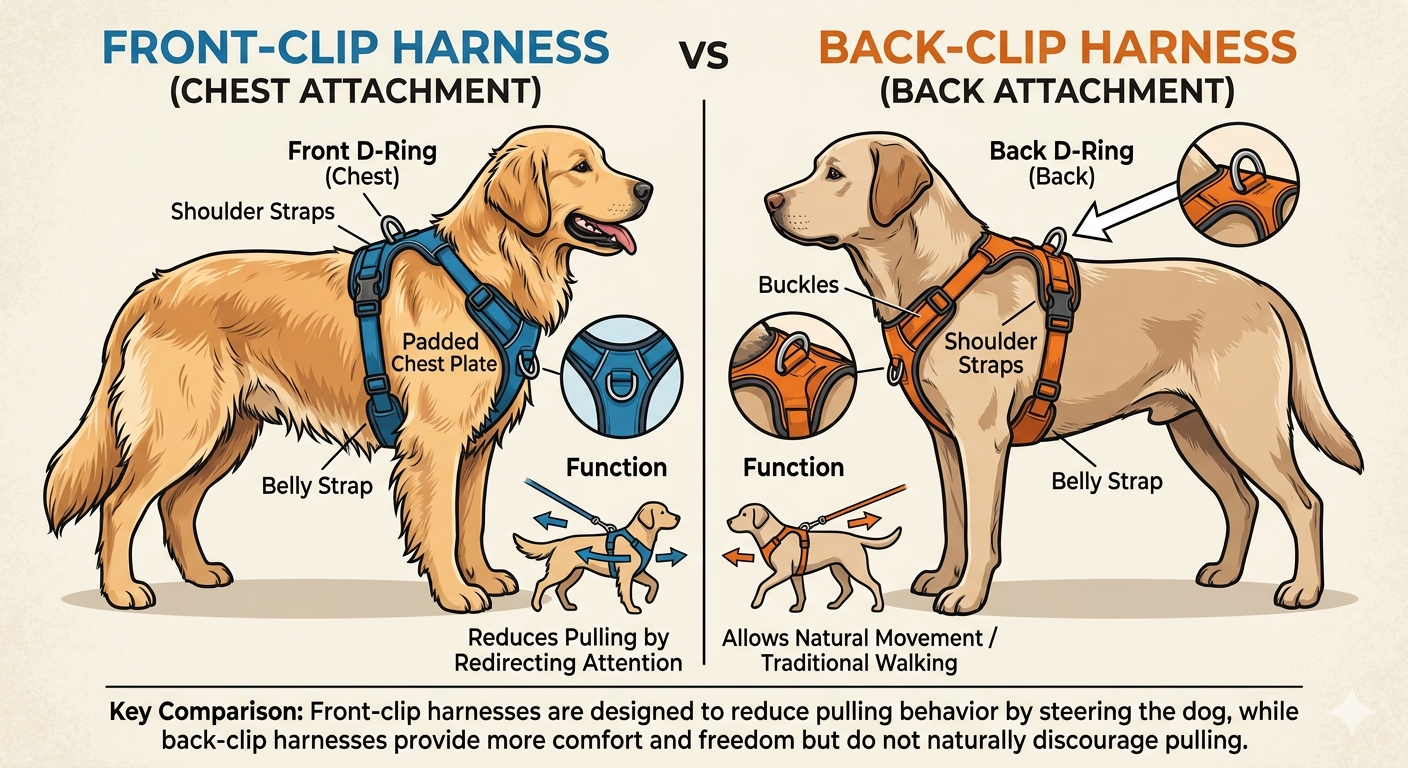
A front-clip harness is a type of dog harness where the leash attachment ring is located on the chest of the dog — at the front of the body. When the dog pulls forward, the leash redirects their momentum sideways, naturally turning them back toward the handler.
This design was developed as a humane alternative to prong collars and choke chains for dogs that pull heavily on leash. The front-clip harness is widely recommended by professional dog trainers and veterinarians for dogs that are still learning leash manners.
How Does a Front-Clip Dog Harness Work?
The mechanics of a front-clip harness are straightforward but effective. The D-ring on the chest strap creates a pivot point. When your dog surges forward and hits the end of the leash, the tension pulls their front body sideways rather than allowing them to barrel straight ahead. This disrupts their pulling momentum and encourages them to look back at you.
Over time, with consistent training, most dogs learn that pulling simply does not work — and they naturally begin walking closer to their owner’s side. This makes the front-clip harness one of the most powerful tools in positive reinforcement-based dog training.
Popular Front-Clip Dog Harness Examples
- Freedom No-Pull Harness
- PetSafe Easy Walk Harness
- Ruffwear Front Range Harness
- 2 Hounds Design Freedom No-Pull Harness
What Is a Back-Clip Harness?
A back-clip harness, also called a rear-clip harness, has its leash attachment ring positioned on the dog’s back — between the shoulder blades or at the center of the back. This is the most traditional and widely available harness configuration on the market.
Back-clip harnesses are popular for their simplicity and ease of use. They are comfortable for the dog, easy to put on and take off, and are ideal for dogs that already walk well on a leash without pulling.
How Does a Back-Clip Dog Harness Work?
A back-clip harness distributes leash pressure evenly across the dog’s body. Because the attachment point is on the back, there is no redirecting mechanism built into the design. When a dog pulls, they feel resistance across their chest and sides — but the direction of force actually allows dogs to lean into their harness and pull more effectively, similar to how sled dogs work.
For dogs without a pulling problem, this is perfectly fine. The even pressure distribution is gentle on the dog’s body, and many dogs find back-clip harnesses more comfortable for extended wear.
Popular Back-Clip Dog Harness Examples
- Kurgo Tru-Fit Smart Harness
- Julius-K9 IDC Powerharness
- Rabbitgoo No-Pull Dog Harness (with back clip)
- Voyager Step-in Air Dog Harness
Figure 2: Front-Clip Harness Redirecting a Pulling Dog — Step-by-Step
Front-Clip vs Back-Clip: Key Differences You Should Know
Now that we understand both harness types, let’s break down the front-clip vs back-clip key differences across multiple categories. This comparison will help you quickly identify which type matches your needs.
Front-Clip vs Back-Clip Comparison Table
| Category | Front-Clip Harness | Back-Clip Harness |
| Leash Position | Chest / Front | Back / Between Shoulders |
| Best For | Pullers & Training | Calm, Trained Dogs |
| Pulling Control | Excellent | Poor to Moderate |
| Comfort Level | Moderate | High |
| Ease of Putting On | Moderate | Easy |
| Risk of Tangling | Moderate (legs) | Low |
| Best Dog Sizes | All Sizes | Small to Large |
| Training Aid | Yes | No |
| Escape Risk | Low | Low to Moderate |
Front-Clip Dog Harness: Pros and Cons
Pros of a Front-Clip Harness
- Reduces pulling behavior effectively through natural redirection mechanics
- Encourages dogs to stay focused on the handler during walks
- Recommended by professional trainers for leash reactivity issues
- Works well for medium to large dogs that are strong pullers
- Helps prevent leash biting and lunging behaviors
- Pairs well with positive reinforcement training techniques
Cons of a Front-Clip Dog Harness
- Leash can sometimes wrap around the dog’s legs, especially in small breeds
- May feel unusual for dogs not used to chest-clip harnesses
- Requires more adjustment to fit correctly
- Not ideal for running, agility, or off-leash activities
- Chest strap can rub against sensitive skin if fitted poorly
Figure 3: Back-Clip Harness for Comfortable, Relaxed Dog Walking
Back-Clip Dog Harness: Pros and Cons
Pros of a Back-Clip Harness
- Extremely comfortable for dogs — even pressure distribution across the body
- Easy to put on and take off, ideal for wriggly dogs
- No risk of leash tangling around front legs
- Wide variety of styles, colors, and materials available
- Great for running, hiking, and outdoor adventures
- Suitable for dogs that are already well-trained on leash
Cons of a Back-Clip Dog Harness
- Can actually encourage pulling behavior in untrained dogs
- Provides very limited control for reactive or strong-pulling dogs
- Not recommended as a training tool for leash manners
- May increase the risk of escape in some designs with inadequate chest straps
- Less effective for redirecting a dog’s attention toward the handler
Front-Clip vs Back-Clip: Which Is Right for Your Dog?
Choosing between a front-clip vs back-clip harness ultimately comes down to your dog’s specific behavior, your training goals, and your everyday walking situation. Here is a breakdown to guide your decision:
Choose a Front-Clip Dog Harness If:
- Your dog pulls constantly and makes walks stressful or unsafe
- You are working on leash manners through positive reinforcement training
- Your dog is reactive to other dogs, people, or stimuli on walks
- You have a strong, large-breed dog that is difficult to control
- Your veterinarian or trainer has recommended a no-pull harness solution
Choose a Back-Clip Dog Harness If:
- Your dog is already well-trained and walks calmly on leash
- You are looking for maximum comfort for long walks or hikes
- You have a small breed dog with a delicate throat or trachea
- You need a harness for running, jogging, or active outdoor activities
- Ease of use and quick on/off capability is a priority for you
Consider a Dual-Clip Dog Harness If:
Many modern harnesses now come with both front and back clip options. A dual-clip harness gives you the flexibility to switch between training mode (front clip) and comfort mode (back clip) depending on the situation. This is often the best choice for dog owners who want the most versatility in a single product.
Figure 4: Front-Clip vs Back-Clip Side-by-Side Use Case Comparison
How to Properly Fit a Front-Clip or Back-Clip Harness
Regardless of whether you choose a front-clip vs back-clip style, proper fit is critical. A poorly fitted harness can cause chafing, restrict movement, or even allow your dog to slip free — creating a dangerous situation.
General Dog Harness Fitting Tips
- Measure your dog’s girth (chest circumference just behind the front legs) and neck size before purchasing.
- Apply the “two-finger rule” — you should be able to slide two fingers under any strap comfortably.
- Check that the front-clip ring sits at the center of the chest, not too high toward the throat.
- Ensure back-clip ring is centered between the shoulder blades, not pulled to one side.
- Check the fit regularly — puppies grow fast, and adult dog weight can fluctuate seasonally.
- Look for signs of rubbing, fur loss, or skin irritation after walks and adjust accordingly.
Learn how to Size your Dog Currently in our Detailed dog harness size Chart guide.
Front-Clip vs Back-Clip for Different Dog Breeds
Different breeds have unique physical builds and behavioral tendencies that make certain harness styles more appropriate than others. Here is how to think about the front-clip vs back-clip decision based on breed type:
Small Breeds (Chihuahua, Pomeranian, Yorkshire Terrier)
Small dogs are often prone to tracheal collapse, making any neck collar a concern. Both front-clip and back-clip harnesses are safe options. For small dogs that are feisty pullers despite their size, a front-clip harness provides useful directional control. For calm small dogs, a soft back-clip harness is typically the most comfortable choice.
Medium Breeds (Beagle, Cocker Spaniel, Bulldog)
Medium breeds benefit most from the front-clip vs back-clip evaluation based on behavior. Scent hounds like Beagles are notorious pullers and typically do better with a front-clip harness. More laid-back breeds like Bulldogs often do fine with a back-clip harness given their typical walking pace.
Large and Giant Breeds (Labrador, German Shepherd, Rottweiler)
For powerful large breeds, the front-clip harness is often the recommended starting point — especially for owners who may struggle to control their dog’s strength. The natural redirection effect is most impactful with large dogs. As training progresses, many owners transition to dual-clip harnesses that offer flexibility between front-clip control and back-clip comfort.
Flat-Faced Breeds (Bulldog, Pug, French Bulldog)
Brachycephalic (flat-faced) breeds have specific respiratory needs. For these dogs, any well-fitted harness is better than a collar. Both front-clip and back-clip options work, but the back-clip harness is often preferred since it keeps all pressure away from the chest area, reducing any breathing discomfort during exertion.
Safety Considerations: Front-Clip vs Back-Clip
Safety should always be the top priority when choosing between a front-clip vs back-clip harness. Here are the most important safety factors to consider:
Leash Entanglement Risk
Front-clip harnesses carry a slightly higher risk of leash entanglement around the dog’s front legs, especially in small or low-slung breeds. If you notice your dog stepping on or tangling in the leash frequently, consider switching to a shorter leash or transitioning to a dual-clip harness.
Pressure Points
Both harness types can create pressure points if they are not properly fitted. The chest strap on a front-clip harness should never press on the dog’s armpits or throat. The back strap on a back-clip harness should sit comfortably across the shoulder blades without restricting the natural forward extension of the front legs when the dog walks.
Escape Prevention
Some back-clip harnesses, particularly simple step-in styles, can be easier for flexible or determined dogs to back out of. Front-clip harnesses with a chest and belly strap design typically offer a more secure fit. Always test the escape potential of any new harness before taking your dog into an unsecured area.
Training Tips: Maximizing Results with Your Harness Choice
Whether you choose a front-clip or back-clip design, the harness itself is only part of the equation. Consistent training makes all the difference in your dog’s leash behavior.
Training Tips for Front-Clip Dog Harness Users
- Reward your dog immediately when they walk beside you with a loose leash
- Stop walking the moment your dog begins to pull — this teaches that pulling gets them nowhere
- Practice direction changes to keep your dog focused on you
- Use high-value treats (chicken, cheese) in high-distraction environments
- Keep training sessions short (10–15 minutes) but frequent for best results
Training Tips for Back-Clip Dog Harness Users
- Maintain a consistent walking pace to help your dog match your rhythm
- Use verbal cues like “let’s go” and “easy” to guide your dog’s speed
- Practice the “heel” command regularly in low-distraction environments first
- Reward calm, focused walking behavior generously and consistently
Frequently Asked Questions (FAQ)
Q: Is a front-clip harness better than a back-clip harness?
Neither is universally “better” — it depends on your dog’s behavior. A front-clip harness is better for reducing pulling and improving leash manners during training. A back-clip harness is better for comfort and ease of use with dogs that already walk well on a leash.
Q: Can a front-clip harness hurt my dog?
A properly fitted front-clip harness should not hurt your dog. However, if the chest strap is too tight or positioned incorrectly, it may cause chafing in the armpit area or restrict shoulder movement.
Q: Do vets recommend front-clip or back-clip harnesses?
Veterinarians generally recommend harnesses over collars for most dogs, especially those with respiratory issues, tracheal problems, or neck injuries. For dogs that pull heavily, many vets and certified dog trainers recommend front-clip harnesses as a humane, effective training tool.
Q: Will a front-clip harness stop my dog from pulling?
A front-clip harness significantly reduces pulling by redirecting your dog’s forward momentum sideways when they lunge ahead. However, it is not a magic fix on its own.
Q: What is a dual-clip harness and should I get one?
A dual-clip harness features both a front chest attachment and a back attachment ring, giving you the flexibility to choose which to use depending on the situation.
Q: Are back-clip harnesses safe for puppies?
Back-clip harnesses are generally safe for puppies and are often the easiest option to fit on a wiggly young dog. However, since puppies are still learning leash manners, a front-clip harness introduced early can help establish good walking habits from the start.
Conclusion: Making the Right Choice in the Front-Clip vs Back-Clip Debate
When it comes to the front-clip vs back-clip harness decision, there is no single right answer for every dog. Both harness types serve important purposes, and understanding their key differences empowers you to make the best choice for your specific situation.
If your dog pulls, lunges, or is still learning leash manners, a front-clip harness is almost always the better starting point. Its natural redirection mechanism is one of the most effective humane tools available for improving walking behavior. If your dog is already calm and well-trained, a back-clip harness offers superior comfort and versatility for everyday walks and outdoor adventures.
Happy walking!