
Getting the right fit for a dog harness is essential for your pet’s comfort, safety, and control during walks. A poorly fitted harness can cause discomfort, restrict movement, or even allow your dog to slip out. That’s why knowing how to properly measure your dog for a dog harness is so important. In this guide, you’ll learn simple steps to measure your dog accurately and choose the perfect dog harness that ensures a secure and comfortable fit every time you head out together.
Why Measuring Matters: The Risks of a Wrong-Fit Dog Harness
Before diving into the how, it’s worth understanding the why. A poorly fitted harness isn’t just uncomfortable — it can be dangerous. A harness that’s too tight restricts your dog’s natural gait, puts pressure on muscles and nerves, and can cause long-term Orthopaedic issues, especially in puppies whose bodies are still developing.
On the other end, a harness that’s too loose creates an entirely different hazard: escape. Dogs — especially anxious ones or those startled by traffic — can back out of a loose harness in seconds. This is sometimes called the “Houdini problem,” and it most commonly occurs when owners size up “for room to grow” or eyeball the fit without measuring.
Taking two measurements with a soft tape measure takes less than two minutes. It can prevent years of discomfort and potential accidents.
The Two Key Measurements You’ll Need
Most harnesses are sized using one or two core measurements. Understanding what each one is — and exactly where to take it — is the foundation of getting the perfect fit.
1. Chest Girth (the most important measurement) of Dog Harness
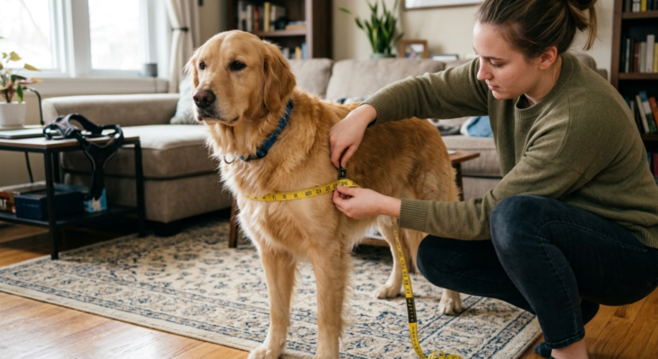
Chest girth — also called the “chest circumference” — is the measurement around the widest part of your dog’s chest, just behind the front legs. This is the primary sizing measurement for virtually every harness on the market, from step-in styles to vest harnesses to H-style harnesses.
| 1 | How to take the chest girth measurement
Have your dog stand squarely on all four paws. Wrap a soft, flexible measuring tape around the widest part of the ribcage, just behind the armpits. Keep the tape parallel to the ground and snug against the fur — not compressing it. Note the number in inches or centimetres. |
| Pro Tip: Add 2 inches to your chest girth reading
Once you have your measurement, add 2 inches (about 5 cm) to find the minimum harness size range you should be shopping in. This allowance ensures freedom of movement and room for the two-finger test. |
2. Neck Circumference of Dog Harness
Some harness styles — particularly over-the-head slip-on designs — require a neck measurement to ensure the neck loop passes comfortably over your dog’s head. Measure around the base of the neck, right where a collar would normally sit. Finally Keep the tape snug but not tight.
3. Back Length (optional, but useful for long-bodied breeds)
For breeds like Dachshunds, Basset Hounds, or Corgis, back length is sometimes needed. Measure from the base of the neck to the base of the tail. This helps avoid harnesses that ride up onto the shoulders or shift backward onto the hips.
Step-by-Step: How to Measure Your Dog
Follow these steps for an accurate, stress-free measurement session.
| 1 | Gather your tools
You’ll need a soft fabric measuring tape (the kind used for sewing). A rigid ruler or metal tape measure won’t contour to your dog’s body. In a pinch, use a piece of string, mark the length, then measure the string against a ruler. |
| 2 | Get your dog into a calm, standing position
Ask your dog to stand on all fours on a flat surface. Avoid measuring while they’re sitting or lying down. Finally If your dog is wiggly, enlist a second person to hold treats at nose level. |
| 3 | Locate the widest chest point
Run your fingers down from the base of the neck and feel for where the ribcage is widest — typically 1-2 inches behind the armpits. On most dogs it’s just behind where the front legs join the body. |
| 4 | Wrap and read
Wrap the measuring tape all the way around the chest at that widest point, keeping it level and parallel to the ground. Record the number — this is your chest girth. |
| 5 | Measure the neck (if needed)
For over-the-head harnesses, wrap the tape around the base of the neck. Keep two fingers between the tape and skin as a natural spacer to get your working neck measurement. |
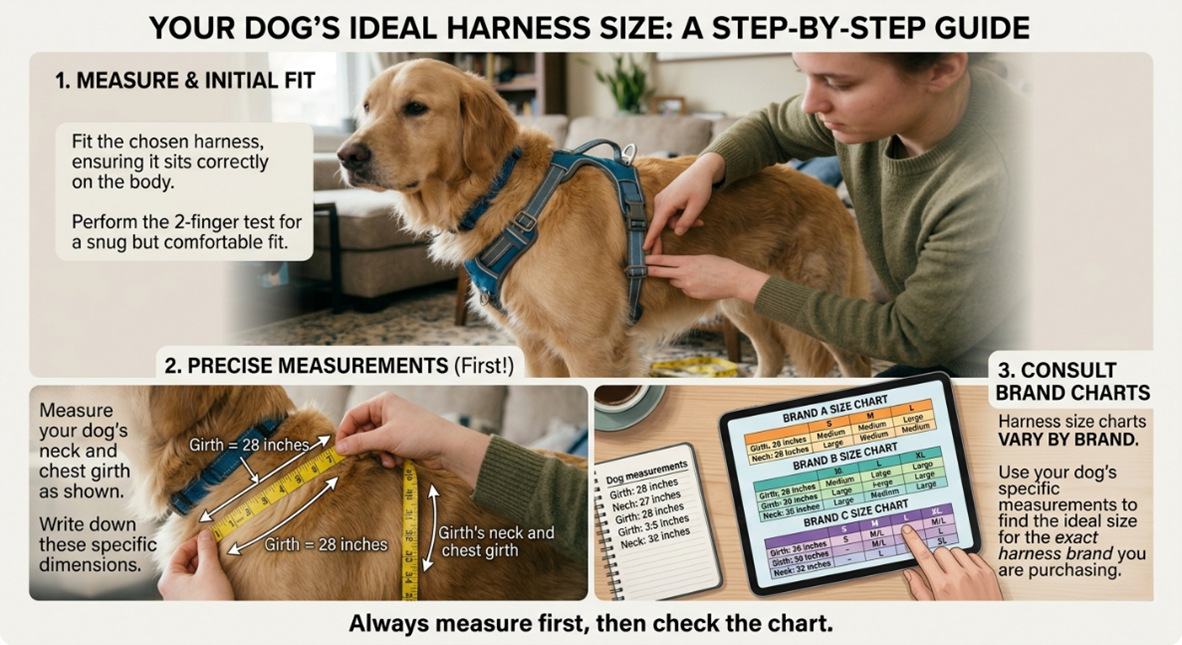
| 6 | Cross-reference with the brand’s size chart
Always use your measurements against the specific brand’s size chart — not a generic one. If your dog falls between sizes, size up for broad-chested breeds, and size down for narrow-chested breeds like Greyhounds. |
The Two-Finger Test: Your Post-Purchase Fit Check of Dog Harness
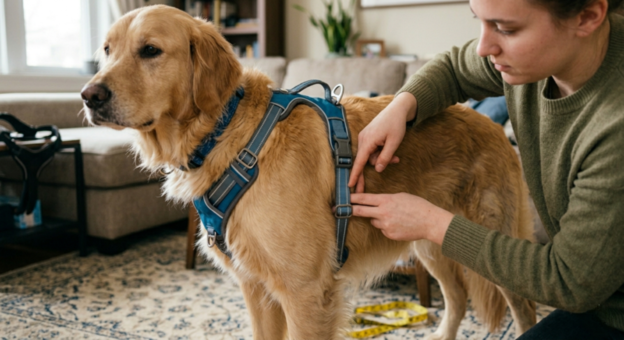
Once you’ve purchased and put on the harness, the two-finger test is the gold standard for confirming the fit is right. Slip two fingers (held flat, not vertical) under each strap of the harness — the chest band, the belly band, and any back straps. You should feel a little resistance but be able to move your fingers freely.
| Warning: Signs the harness fits incorrectly
Watch for these red flags after putting the harness on: rubbing or raw skin under the armpits; the harness rotating to one side; the back D-ring sitting Off-Centre on the spine; your dog scratching at the harness constantly; In Addition or visible skin bunching under any strap. |
Dog Harness Size Chart by Breed & Weight
Use this general reference chart to cross-check your measurements against typical size ranges. Always prioritize your dog’s actual chest measurement over their weight.
| Size | Chest Girth | Weight (approx.) | Example Breeds |
| XXS | 10–14 in / 25–36 cm | 2–5 lb | Chihuahua, Pomeranian |
| XS | 14–17 in / 36–43 cm | 5–10 lb | Toy Poodle, Yorkshire Terrier |
| S | 17–21 in / 43–53 cm | 10–20 lb | Shih Tzu, French Bulldog |
| M | 21–27 in / 53–69 cm | 20–45 lb | Beagle, Cocker Spaniel, Bulldog |
| L | 27–34 in / 69–86 cm | 45–80 lb | Labrador, Border Collie, Boxer |
| XL | 34–40 in / 86–102 cm | 80–110 lb | German Shepherd, Golden Retriever |
| XXL | 40+ in / 102+ cm | 110+ lb | Great Dane, Mastiff, Bernese Mountain Dog |
Measuring for Different Dog Harness Types
Not all harnesses are built the same way — and the measurements that matter most vary by harness style.
Step-in harnesses
These require chest girth and sometimes neck circumference. Your dog steps their front paws into two loops and the harness clips over the back. Ideal for dogs that resist having things pulled over their heads.
Over-the-head vest harnesses
The neck loop must pass over your dog’s head, so neck circumference is critical. Whereas Chest girth determines the body panel sizing. Measure both before purchasing.
H-style (figure-8) harnesses
Classic H-harnesses use chest girth as the primary measurement and are among the most adjustable styles available, However making them a good choice for growing puppies or dogs between sizes.
No-pull front-clip harnesses
These have a front D-ring at the sternum and redirect pulling. Fit is especially important here — if the straps are loose, the redirection mechanism loses effectiveness. Although Measure chest girth precisely and err toward a snugger fit within the recommended range.
Measuring Puppies: Special Considerations
Puppies grow fast — some double their chest measurement in just a few months. When buying a first harness for a puppy, consider a highly adjustable harness rather than buying to their current measurement. Moreover Measure their chest every 3-4 weeks and check the fit regularly.
| Tip for deep-chested breeds
Breeds like Greyhounds, Whippets, Dobermans, and Great Danes have unusually deep, narrow chests. Their chest girth may read as a “medium” while their body length demands a “large.” Look for harnesses specifically designed for deep-chested breeds. |
How Often Should You Re-Measure?
For adult dogs at a stable healthy weight, re-measuring once a year is sufficient. For puppies, measure every 4-6 weeks during rapid growth phases. If your dog gains or loses more than 10% of their body weight, re-measure before every walk season.
- Re-measure puppies every 4-6 weeks during growth
- Re-check fit after significant weight gain or loss
- Inspect harness for wear and broken buckles monthly
- Confirm two-finger test every time you put the harness on a new dog
- Check for armpit rubbing after every first use of a new harness
Frequently Asked Questions
Q. What if my dog is between harness sizes?
If your dog’s chest measurement falls between two sizes, size up for barrel-chested, stocky, or muscular breeds. Size down for slender or narrow-chested breeds. Most quality harnesses have at least 3-4 inches of adjustment range.
Q. Can I use my dog’s weight instead of measuring?
Weight alone is not reliable for harness sizing. Two dogs that both weigh 25 lb can have chest girths that differ by 4-6 inches. Always measure the actual chest circumference for an accurate fit.
Q. How tight should a dog harness be?
The harness should be snug enough that it doesn’t rotate on your dog’s body, but loose enough for you to slide two flat fingers under each strap without effort. Also It should not restrict breathing or leave red marks after removal.
Q. Do I need to measure for a specific harness brand?
Yes, absolutely. Sizing conventions differ significantly between brands. A size ‘Medium’ from one manufacturer may correspond to a ‘Large’ from another. Always use your raw measurements against the specific brand’s sizing chart.
Q. My dog hates being measured — any tips?
Work in short sessions with high-value treats. Let your dog sniff the tape first, reward calmness, then wrap it briefly and reward again. Enlist a second person to hold treats at eye level while you measure.
Q. Does coat thickness affect the harness size?
Yes — for heavily coated breeds like Huskies, Samoyeds, or Poodles, your tape measure reads through a thick layer of fur. If your dog’s coat is especially dense, consider sizing up one size or measuring when the coat is flat.
| Key Takeaways:
Measuring your dog for a harness comes down to two numbers: chest girth (the most important) and neck circumference. Take both measurements with a soft tape while your dog stands calmly, Also add 2 inches to the chest girth for working room, and always cross-reference with the specific brand’s size chart. Once the harness is on, verify the fit with the two-finger test on every strap. Whereas Re-measure puppies frequently, and revisit sizing any time your dog’s weight changes. A well-fitted harness makes walks safer, more comfortable, and more enjoyable for both you and your dog. |
Suggested External Authority References:
- American Kennel Club – https://www.akc.org/ ( Nonprofit Organization for American Dog Culture & Breed Ethics.
- ASPCA – https://www.aspca.org/ ( Nonprofit American welfare organization for dogs cruelty.)
- RSPCA – https://www.rspca.org.au/ ( Community Based Organization for aminal care service.)