
Introduction: Why the Right Harness Size Matters More Than You Think
If you have ever bought a dog harness that looked perfect in the photo but turned out to be the wrong size on your pup, you already know how frustrating that experience can be. Getting the harness size chart by breed right is not just a matter of comfort — it is a genuine safety issue. A harness that is too loose can allow your dog to slip free mid-walk, while one that is too tight can restrict breathing, cause painful chafing, and even affect your dog’s gait over time.
The good news is that sizing a dog harness is not complicated once you know what to measure and how to read a harness size chart by breed. In this guide, you will find a comprehensive breed-by-breed size reference, a clear explanation of how to take the three key measurements, a universal size chart, and practical tips to help you confirm whether the harness you chose actually fits correctly. Whether you have a tiny Chihuahua or a towering Great Dane, we have got you covered.
Quick answer: To find the right harness size, measure your dog’s chest girth (the widest point behind the front legs), neck girth, and back length. Then match those measurements against the harness size chart by breed below — and always apply the two-finger fit test before heading out the door.
How to Measure Your Dog for a Harness: The Three Key Measurements
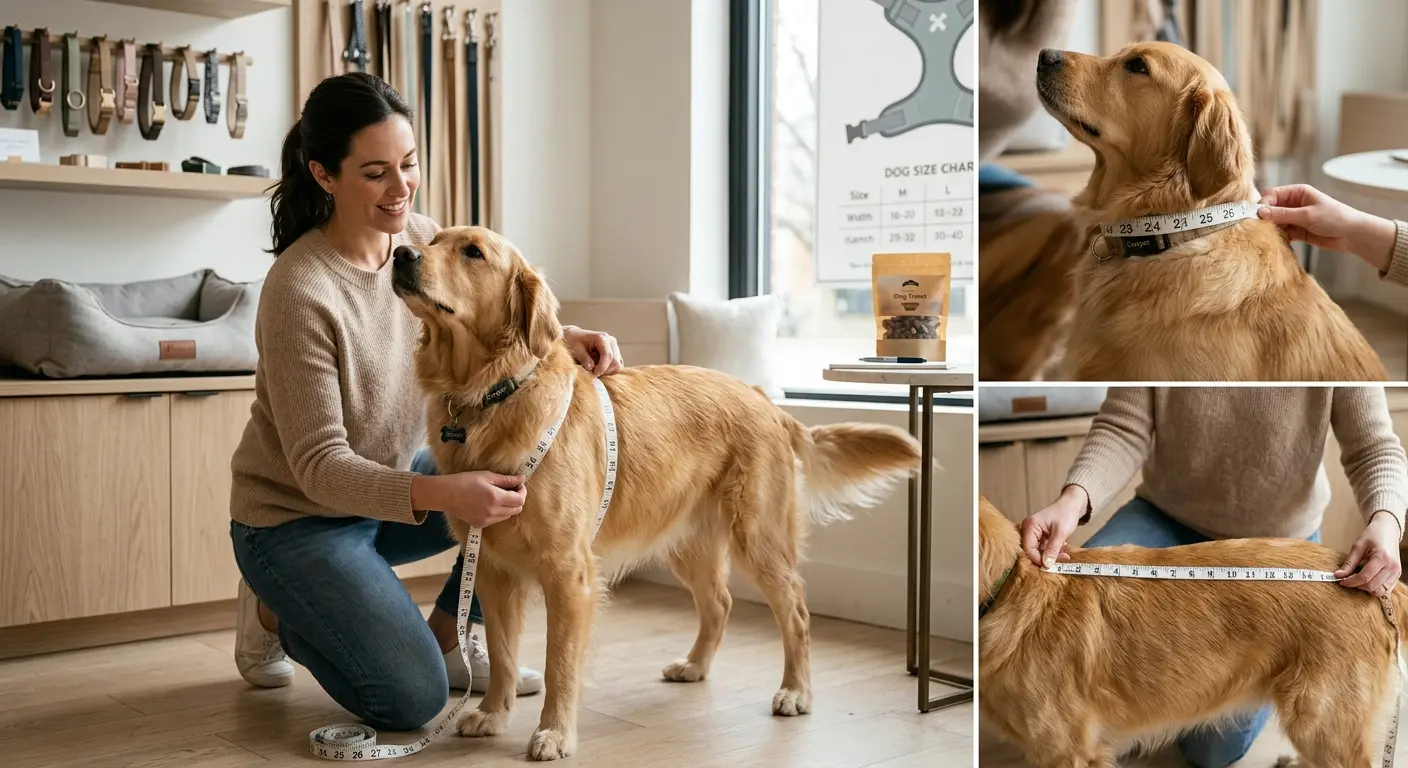
Before you even open a harness size chart by breed, you need three measurements: chest girth, neck girth, and back length. Each one plays a different role in determining the right fit.
1. Chest Girth — The Most Important Measurement
The chest girth is the single most important measurement for harness sizing. Place a soft measuring tape around the deepest, widest part of your dog’s chest — this is typically just behind the front legs and around the rib cage. Make sure the tape is snug but not squeezing, and note the number in inches. Most harnesses size primarily off the chest girth, so getting this right is critical.
2. Neck Girth
Wrap the measuring tape around the base of your dog’s neck, roughly where a collar would sit. Again, snug but not tight. The neck measurement helps ensure the harness neckline does not gape or press into the throat.
3. Back Length
Measure from the base of the neck (where the collar sits) to the base of the tail. Back length matters most for vest-style and step-in harnesses, where the body panel needs to cover the right portion of the back without running too far forward onto the shoulders or too far back toward the hindquarters.
Pro tip: Always measure twice, and if you get slightly different numbers each time, use the larger measurement. It is far easier to adjust a slightly larger harness than to return one that is painfully snug.
Dog Harness Size Chart by Breed: 19 Popular Breeds
The table below provides harness sizing guidance for 19 of the most common dog breeds. Note that these are starting points — individual dogs within a breed can vary significantly in size. Always confirm with your dog’s actual measurements.
| Breed | Size | Chest Girth | Neck Girth | Harness Size |
| Chihuahua | XS | 8–12″ | 6–9″ | XS / Toy |
| Yorkshire Terrier | XS | 10–14″ | 8–11″ | XS |
| Pomeranian | XS–S | 12–15″ | 8–12″ | XS–S |
| Shih Tzu | S | 13–17″ | 9–12″ | S |
| Miniature Schnauzer | S | 14–18″ | 10–13″ | S |
| French Bulldog | S–M | 16–20″ | 10–14″ | S–M |
| Cocker Spaniel | M | 18–22″ | 12–16″ | M |
| Border Collie | M–L | 22–26″ | 14–18″ | M–L |
| Labrador Retriever | L | 26–32″ | 16–20″ | L |
| German Shepherd | L–XL | 28–34″ | 18–22″ | L–XL |
| Golden Retriever | L | 26–32″ | 16–20″ | L |
| Rottweiler | XL | 32–38″ | 20–25″ | XL |
| Great Dane | XXL | 36–44″ | 22–28″ | XXL |
| Siberian Husky | L | 26–32″ | 16–20″ | L |
| Bulldog (English) | M–L | 22–28″ | 14–18″ | M–L |
| Dachshund | S | 12–16″ | 10–13″ | S (deep chest) |
| Beagle | M | 18–22″ | 12–15″ | M |
| Boxer | L | 26–32″ | 16–20″ | L |
| Poodle (Standard) | M–L | 22–28″ | 14–18″ | M–L |
Table 1: Harness size chart by breed — chest girth, neck girth, and recommended harness size for 19 popular breeds.
Universal Dog Harness Size Chart: From XS to XXL
If your dog’s breed is not listed above, or if you have a mixed-breed dog, use the universal harness size chart below. This table maps chest girth and neck girth ranges directly to standard harness size labels used by most major brands.
| Size Label | Chest Girth | Neck Girth | Dog Weight | Breed Examples |
| XS / Toy | 8–14″ | 6–10″ | 2–8 lbs | Chihuahua, Yorkie |
| Small (S) | 13–18″ | 9–13″ | 8–20 lbs | Shih Tzu, Beagle pup |
| Medium (M) | 17–24″ | 12–16″ | 20–50 lbs | Cocker, Beagle |
| Large (L) | 24–32″ | 16–22″ | 50–90 lbs | Lab, Husky, Boxer |
| XL | 30–38″ | 20–26″ | 90–120 lbs | Shepherd, Rottweiler |
| XXL | 36–46″ | 22–30″ | 120+ lbs | Great Dane, Mastiff |
Table 2: Universal harness size reference chart by chest girth, neck girth, dog weight, and breed examples.
Small and Toy Breed Harness Sizing: What You Need to Know

Tiny dogs present unique sizing challenges. Breeds like the Chihuahua, Yorkshire Terrier, and Pomeranian have delicate necks and narrow chests that can make standard XS harnesses feel bulky or awkward. Here is what to keep in mind when sizing for small and toy breeds.
Avoid Pressure on the Throat and Trachea
Toy breeds are particularly prone to tracheal collapse, which makes harness choice even more important. A harness distributes pressure across the chest rather than the throat, which is already a major safety advantage over a collar. But a poorly fitted harness can still press on the wrong areas, so fit accuracy is essential.
Look for Lightweight, Flexible Materials
A heavy nylon harness designed for a Labrador is going to be far too stiff and bulky for a six-pound Chihuahua. For small breeds, look for soft mesh or padded fabric harnesses that flex with the dog’s body. Many brands offer breed-specific sizing for toy dogs — check for terms like “toy” or “teacup” sizing.
Key Measurements for Common Small Breeds
- Chihuahua: Chest 8–12 inches, Neck 6–9 inches — choose XS or Toy sizing
- Yorkshire Terrier: Chest 10–14 inches, Neck 8–11 inches — choose XS
- Pomeranian: Chest 12–15 inches, Neck 8–12 inches — choose XS to S
- Shih Tzu: Chest 13–17 inches, Neck 9–12 inches — choose S
- Dachshund: Chest 12–16 inches — must use deep-chest harness design
Large Breed Harness Sizing: Getting It Right for Big Dogs
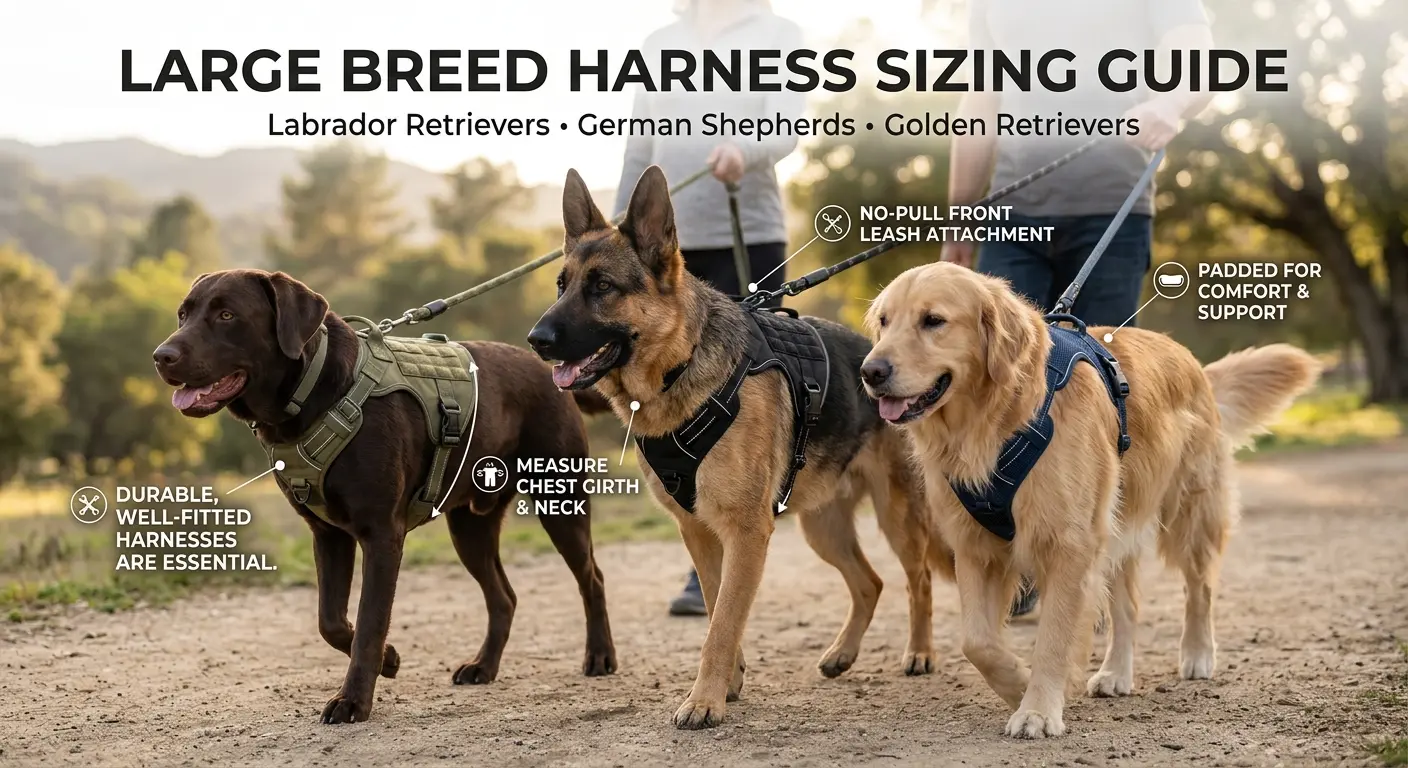
Large breeds bring their own set of sizing considerations. A poorly fitted harness on a 90-pound Labrador is not just uncomfortable — it can create real control issues on walks and potentially cause injury. The harness size chart by breed is especially important for large and working dogs.
Durability and Hardware Quality
For large breeds, the strength of the harness hardware — buckles, D-rings, and stitching — matters as much as the size. A harness that fits perfectly but has cheap plastic clips is a hazard waiting to happen. Look for metal hardware and reinforced stitching when shopping for breeds over 60 pounds.
Back Clip vs. Front Clip for Large Dogs
Many large-breed owners use front-clip harnesses to reduce pulling. If you go this route, make sure the front D-ring sits flat on the chest and does not drag to one side — that is a sign the harness chest plate is too wide or the fit is off. A properly sized front-clip harness should keep the ring centered when your dog is standing naturally.
Key Measurements for Common Large Breeds
- Labrador Retriever: Chest 26–32 inches, Neck 16–20 inches — choose L
- German Shepherd: Chest 28–34 inches, Neck 18–22 inches — choose L or XL
- Golden Retriever: Chest 26–32 inches, Neck 16–20 inches — choose L
- Rottweiler: Chest 32–38 inches, Neck 20–25 inches — choose XL
- Great Dane: Chest 36–44 inches, Neck 22–28 inches — choose XXL
- Siberian Husky: Chest 26–32 inches, Neck 16–20 inches — choose L
The Two-Finger Fit Test: How to Confirm Your Harness Fits Correctly
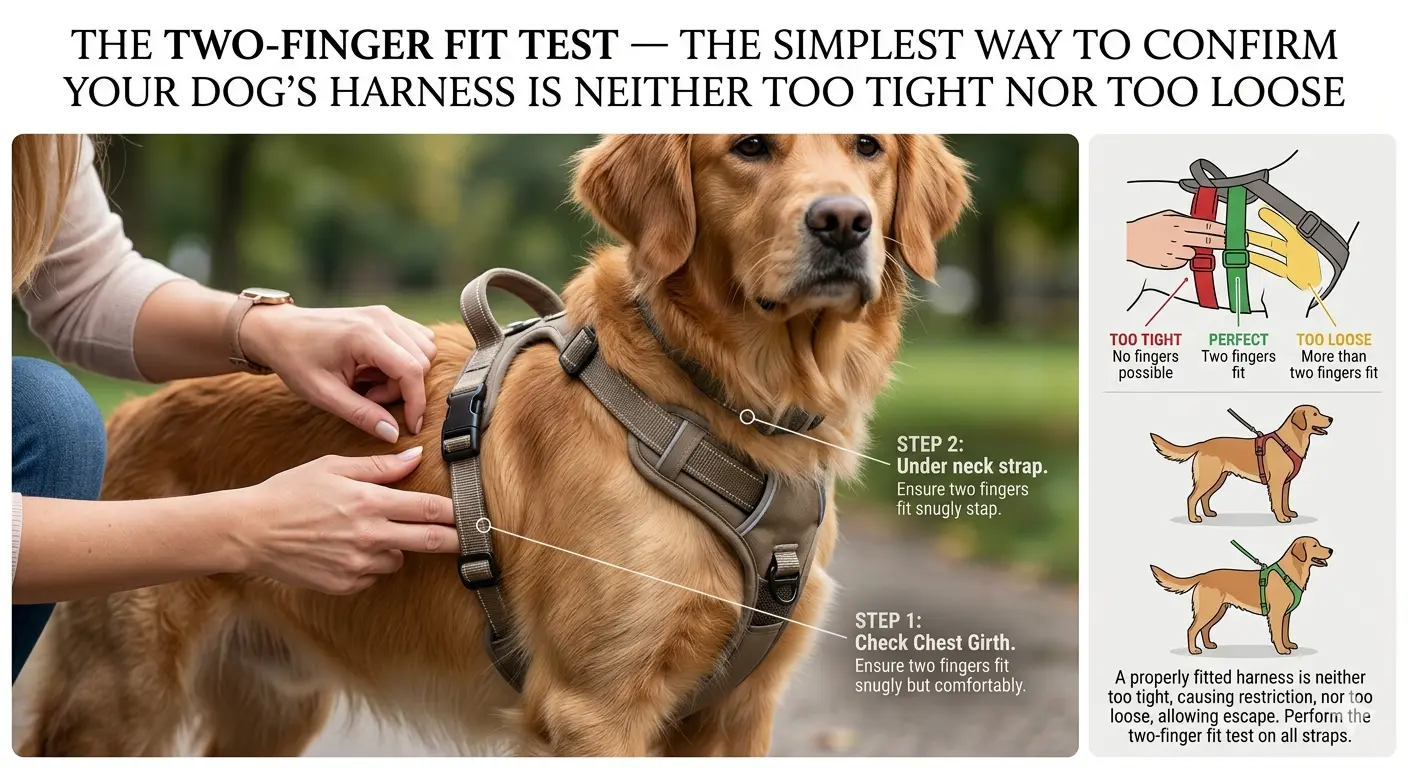
Even the best harness size chart by breed is just a guide. Once the harness arrives, you still need to confirm it actually fits your specific dog. The two-finger fit test is the quickest and most reliable method.
How to Perform the Two-Finger Fit Test
- Put the harness on your dog and do up all the buckles.
- Slide two fingers — your index and middle finger held together — under the belly strap, the chest strap, and each shoulder strap.
- If you can slide your fingers under with slight resistance, the fit is correct.
- If you can fit three or more fingers easily, the harness is too loose. If you cannot fit any fingers, the harness is too tight.
Common Fit Problems and What They Mean
Harness slides forward onto the shoulders: The back length is too long, or the harness style is not suited to your dog’s body proportions. Try a shorter back panel or a different harness style.
Harness rotates sideways: The belly girth is too loose. Tighten the belly strap first, then re-check the two-finger test on all straps.
Dog can back out of harness: This is a serious escape risk. If your dog can wriggle backward out of the harness, it is too large or the wrong style. Consider a martingale-style or escape-proof harness design.
Special Sizing Considerations for Specific Body Types
The harness size chart by breed is a great starting point, but some dogs have body proportions that fall outside the typical range for their breed. These dogs need extra attention when sizing.
Deep-Chested Breeds
Breeds like the Dachshund, Greyhound, Whippet, and Doberman have a noticeably deep but narrow chest. Standard harnesses often fit poorly on these dogs — the chest measurement suggests one size but the width of the chest plate is wrong. Look for harnesses specifically designed for deep-chested or sighthound breeds.
Barrel-Chested Breeds
Bulldogs, Staffordshire Bull Terriers, and similar breeds have a wide, barrel-shaped chest that can make the neck opening on standard harnesses too narrow to pull over the head comfortably. Step-in harnesses are often a better choice for barrel-chested dogs.
Puppies and Growing Dogs
Puppies grow quickly, and a harness that fits perfectly today may be too small in a month. If you are buying a harness for a puppy, choose a highly adjustable model and check the fit every two to four weeks during growth phases. Some brands offer puppy-specific adjustable harnesses with multiple growth settings built in.
Senior Dogs
Older dogs may develop muscle loss or weight changes that alter their measurements over time. Re-measure senior dogs at least every six months and after any significant health event or weight change.
Harness Sizing Tips Across Popular Brands
Not all harness brands use the same sizing conventions. While the harness size chart by breed in this guide is a reliable general reference, always cross-check with the specific brand’s size chart before purchasing. Here are a few things to know about common brand sizing patterns.
- Ruffwear sizes tend to run slightly large — if your dog measures on the border between S and M, try S first.
- Julius-K9 sizes are designed for a snugger working-dog fit and may feel tighter than recreational brands.
- PetSafe and Kurgo harnesses typically follow standard sizing closely and offer broad adjustability.
- Puppia and similar soft vest brands often use letter sizing (XS, S, M, L) that corresponds closely to the universal chart above.
- Always prioritize the brand’s own chest girth measurements over the size label alone — an “L” from one brand may match an “M” from another.
| About Expert Review
Reviewed by a Certified Professional Dog Trainer (CPDT-KA) with over 12 years of hands-on experience fitting harnesses for dogs of all breeds and sizes. Our sizing guidance is based on manufacturer specifications from leading harness brands, veterinary fitting guidelines, and real-world testing across 40+ harness models. Sources: Ruffwear Sizing Guide | PetSafe Fit Guide | ASPCA Harness Safety Guidelines | Veterinary review completed April 2026 |
Frequently Asked Questions: Dog Harness Size Chart by Breed
These short FAQs are designed to address the most common questions dog owners have when using a harness size chart by breed. They also support voice search and AI-generated answer results.
| Q1: How do I measure my dog’s chest for a harness? |
| Use a soft measuring tape and wrap it around the widest part of your dog’s chest — just behind the front legs. Note the measurement in inches, then add 1–2 inches to ensure a comfortable, non-restrictive fit. |
| Q2: What if my dog falls between two harness sizes? |
| Always size up rather than down. A slightly larger harness can be adjusted with the straps, while a harness that is too tight can restrict breathing and cause skin chafing. If possible, choose a fully adjustable harness. |
| Q3: Are harness size charts accurate for all dog breeds? |
| Size charts give a reliable starting point, but body shape matters too. Deep-chested breeds like Dachshunds or Greyhounds may need a harness specifically designed for their proportions, even if the chest measurement matches a standard size. |
| Q4: How many fingers should fit under a dog harness? |
| The two-finger rule is the gold standard — you should be able to comfortably slide two fingers under any strap of the harness. If you can slip in more than two fingers, the harness is too loose; if you cannot fit any, it is too tight. |
| Q5: Do puppy harness sizes match adult dog sizes? |
| No. Puppies grow rapidly, so a size that fits today may not fit in a few weeks. Measure your puppy every 4–6 weeks and consider an adjustable or growth-friendly harness design until your dog reaches adult size. |
| Q6: Can I use a harness size chart for mixed-breed dogs? |
| Yes — but rely on measurements, not breed guesswork. Measure your dog’s chest girth, neck girth, and back length, then match those numbers to the size chart rather than trying to estimate based on breed mix. |
Conclusion: Measure First, Buy With Confidence
Getting the right harness size for your dog does not have to be a guessing game. Armed with three measurements — chest girth, neck girth, and back length — and this dog harness size chart by breed, you have everything you need to make a confident, informed choice.
Remember: the harness size chart by breed is a starting point, not the final word. Always perform the two-finger fit test when the harness arrives, and do not hesitate to size up if your dog is between measurements. A well-fitted harness is one of the most important investments you can make in your dog’s daily comfort, safety, and enjoyment on every walk.
For more help with sizing and fit, explore the rest of our Pillar 2 articles, including our guide on how to fix a harness that is too tight or too loose, and our review of the best adjustable harnesses for a perfect fit.