
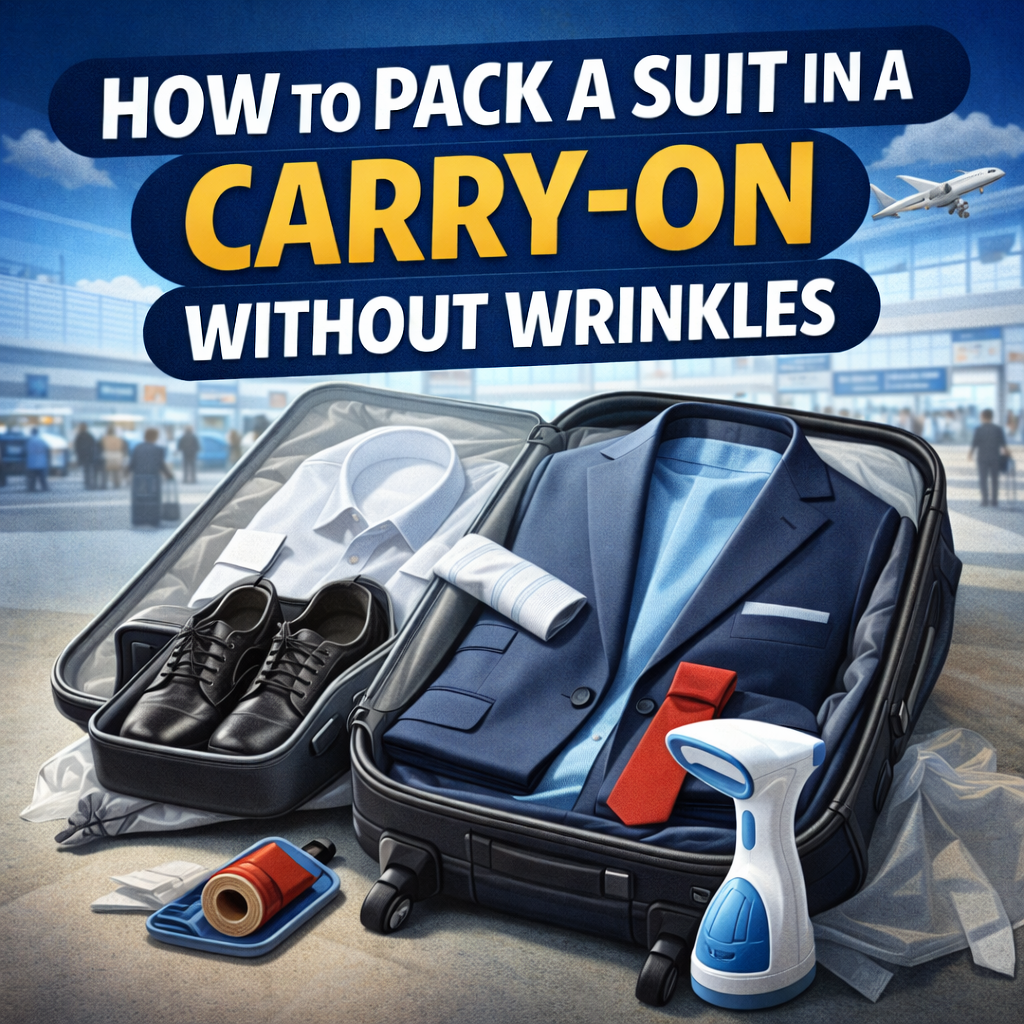
You’ve got a big meeting in the morning, a flight landing at 10 PM, and one carry-on bag standing between you and a wrinkled disaster. Sound familiar? If you’re wondering How to pack a suit in a carry-on without wrinkles, you’re not alone. It is one of the most common challenges business travelers face—but it does not have to be stressful. With the right folding technique, the right bag, and a quick recovery trick after arrival, your suit can come out looking like it never left the hanger.
In this guide, you’ll learn How to pack a suit in a carry-on without wrinkles using three proven methods for packing a suit jacket and trousers into carry-on luggage wrinkle-free. In addition, you’ll discover expert tips for business trips, weddings, fabric selection, and fast de-wrinkling techniques when you arrive.
Here’s the quick overview:
- Choose a carry-on with at least 40L of usable space
- Pick the folding method that matches your jacket type
- Pack the suit last, on top of softer items
- Use tissue paper or a dry-cleaning bag between folds
- Hang the suit immediately upon arrival
- Steam or use a wrinkle-release spray if needed
Why It’s Harder Than It Looks — and Why It Matters
The Science of Fabric and Fold Lines
Wrinkles form when fabric fibres are compressed and held in place long enough to “set” in that position. The longer a suit sits folded — especially under pressure from other items in a packed bag — the more defined those fold lines become. Heat and humidity (like the dry recycled air in a plane cabin) accelerate the process.
The challenge is that a suit jacket is a tailored three-dimensional garment. It has structure built into the shoulders, chest, and lapels. Flatten it carelessly and you can permanently distort that structure, not just create surface creases.
When a Carry-On Is Your Only Option
Checking luggage adds risk: bags get delayed, transferred roughly, and exposed to temperature extremes. For one- or two-night business trips, a carry-on is almost always the smarter move. You save time at baggage claim, avoid fees, and maintain control of your suit at every stage of the journey.
The key is treating your suit as the most important item in the bag — because on arrival day, it is.
What You’ll Need Before You Start Packing
Choosing the Right Carry-On Bag
Not every carry-on is created equal for suit transport. You need:
- Minimum dimensions of 56 x 36 x 23 cm (the standard IATA carry-on limit) with a rectangular interior that gives the suit room to lie flat
- 40L+ capacity — suits need horizontal real estate; cramming them into a slim 30L bag causes more folds and more pressure points
- A structured frame — soft-sided bags compress under overhead bin pressure; hard-shell or semi-rigid cases protect the suit better
Bags with a dedicated garment section or a zippered lay-flat compartment are worth the investment if you travel with suits more than four times a year. Brands like Briggs & Riley, Tumi, and Horizn Studios all make carry-ons with this feature built in.
Essential Packing Accessories
You don’t need much, but these three items make a measurable difference:
- Dry-cleaning bags (polythene): Placing one between folded layers reduces friction and allows the fabric to slide rather than crease when compressed. This single trick, borrowed from professional garment handlers, is the most underrated packing hack in existence.
- Tissue paper: An alternative to dry-cleaning bags; works especially well stuffed into jacket shoulders to maintain their shape.
- Travel steamer or wrinkle-release spray: For the arrival end of the journey, not the packing end. More on this below.
Best Suit Fabrics for Travel
If you’re buying a travel suit — or choosing which suit to take on a trip — fabric selection matters enormously.
- Wool-polyester blends: The gold standard for travel. The synthetic component adds resilience and snap-back. A 70/30 wool-polyester blend will recover from a day in a bag far better than pure wool.
- Merino wool: Naturally wrinkle-resistant and breathable. Heavier merino (280gsm+) holds its shape well packed.
- Tropical wool: Lightweight, open-weave construction means less fabric pressing against itself — a natural advantage for carry-on packing.
- Avoid: Pure linen, raw cotton, and heavily canvassed pure wool suits — these crease badly and recover slowly without professional pressing.
Method 1: The Ranger Roll (Military Fold Technique)
The ranger roll is the most compact method and works best for unstructured or soft-shouldered jackets. It’s the technique most professional travellers learn first.
How to Fold the Jacket
- Lay the jacket face-down on a flat surface (a bed or large table).
- Fold the left shoulder inside out, then tuck the right shoulder into the left — so both shoulders nest together and the jacket is now inside-out with the lining facing outward.
- Smooth out the back panel completely — any pre-existing folds here will become permanent creases.
- Fold the jacket in half lengthwise so the two sleeves align.
- Starting from the bottom hem, roll the jacket tightly upward toward the collar. Keep the roll firm and even — loose rolling creates uneven pressure.
- Slip the roll into a dry-cleaning bag before placing it in the suitcase.
How to Fold the Trousers
- Hold the trousers by the waistband and let them hang — gravity will align the natural crease.
- Fold along the crease line so the legs lie perfectly on top of each other.
- Lay flat and fold the waistband down about 20cm to create a cuff.
- Roll from the hem upward, keeping the crease line centred throughout.
- The finished roll should be compact enough to sit beside the jacket roll in the bag.
Layering Everything in the Bag
Place the rolled suit pieces on top of softer items (t-shirts, underwear) which act as cushioning. The suit should be the last thing in and the first thing out. Avoid placing hard items — shoes, toiletry bags, laptops — directly against the suit fabric.
Method 2: The Inside-Out Jacket Fold
This is the most widely recommended method for structured, canvassed jackets where shoulder shape needs to be preserved. It creates slightly more volume than the ranger roll but far less risk of shoulder distortion.
Step-by-Step Jacket Inversion
- Hold the jacket by the collar, facing you.
- Put your hand inside the left shoulder and push it outward — you’re turning the left shoulder inside out.
- Place the right shoulder inside the inverted left shoulder so they’re nested together.
- The jacket is now folded in half lengthwise, with the lining on the outside and the shoulders protected inside.
- Smooth the back flat. Fold the bottom third up toward the chest — one fold only.
- Slide into a dry-cleaning bag and place flat in the bottom of the carry-on (if it’s a hard-shell case) or on top of clothes (if soft-sided).
Best For: Structured vs Unstructured Jackets
- Structured jackets (fused or canvassed): Always use the inside-out method. The nested shoulders protect the padding and canvas from compression.
- Unstructured jackets (soft Italian style, linen blends): Either method works; the ranger roll may be preferable for its compactness.
Method 3: Using a Travel Garment Bag Inside a Carry-On
A folding garment bag eliminates most of the compromise. You hang the suit normally in the garment bag, then fold the bag in half or thirds — the suit folds with it but never touches the interior of the suitcase directly.
Folding the Garment Bag Without a Fold
The trick is to fold the garment bag at the natural midpoint of the jacket — just below the chest — rather than at an arbitrary point. This means the fold line falls in a less visible part of the garment. For trousers, fold at mid-thigh.
Modern folding garment bags (like those from Eagle Creek or Travelpro) have a built-in fold bar that positions the fold correctly every time. If yours doesn’t, use a rolled magazine or a thin cardboard tube as a fold bar — wrap it at the midpoint so fabric drapes over a curved surface rather than a sharp edge.
Top Carry-On Bags with Garment Sections
If you’re upgrading your luggage, the following carry-ons have built-in garment compartments rated consistently well by frequent travellers:
- Briggs & Riley Baseline Carry-On: Wide-body design with a compression lid ideal for garment bags
- Tumi Alpha 3 International: Dedicated garment section with interior suiting straps
- Travelpro Platinum Elite: Excellent value, lay-flat suiter with fold bar included
- Horizn Studios M5: Sleek hard-shell with a flexible interior panel for flat-packing
What to Do When You Arrive: De-Wrinkling Fast
Steam Trick With a Hot Shower
Hang the suit on a hanger in your hotel bathroom. Run the hottest shower available with the door closed for 10–15 minutes. Don’t put the suit in the shower — just let the steam fill the room. The moisture relaxes the fabric fibres and gravity pulls the wrinkles out.
This works best on wool and wool-blend suits. Give the suit 20–30 minutes to dry and cool before wearing — putting on a still-damp suit causes new creases to form immediately.
Travel Steamers Worth Carrying
If you travel with a suit more than once a month, a compact travel steamer pays for itself in avoided dry-cleaning bills and stress. Look for:
- Conair Turbo ExtremeSteam: Compact, heats in 45 seconds, widely available
- Rowenta Travel Steamer: Slightly larger but more powerful; better for heavy fabrics
- Fridja f10e: Premium option, continuous steam output without the 30-second pauses cheaper models have
Keep the steamer moving at all times — holding it in one spot saturates the fabric and can leave water marks.
Wrinkle-Release Spray: Does It Actually Work?
Yes, with caveats. Wrinkle-release sprays (Downy Wrinkle Releaser is the category benchmark) work by relaxing fabric fibres temporarily. Lightly mist the suit — don’t soak it — then pull the fabric taut with your free hand and let it air-dry for five minutes.
Results are noticeably better on lighter fabrics and minor creases. For deep fold lines set during a long overnight flight, steam is more effective. Use the spray as a touch-up tool, not a primary recovery method.
Expert Tips for Specific Occasions
Packing for a Job Interview or Court Appearance
For important presentations, the stakes are highest, so knowing How to pack a suit in a carry-on without wrinkles becomes essential. Use Method 2 (inside-out fold) regardless of the jacket style because it offers the best protection against creases during travel. In addition, place the suit inside a garment bag before packing it into your carry-on instead of laying it loose inside the suitcase.
If you truly want to master How to pack a suit in a carry-on without wrinkles, bring a travel steamer rather than relying on the hotel’s iron. Hotel irons can scorch delicate suit fabric or flatten the lapel roll. Whenever possible, arrive the night before your meeting. Giving your suit at least 8 hours to hang and recover remains the most reliable wrinkle-prevention strategy.
Wedding Travel: Packing a Full Suit and Accessories
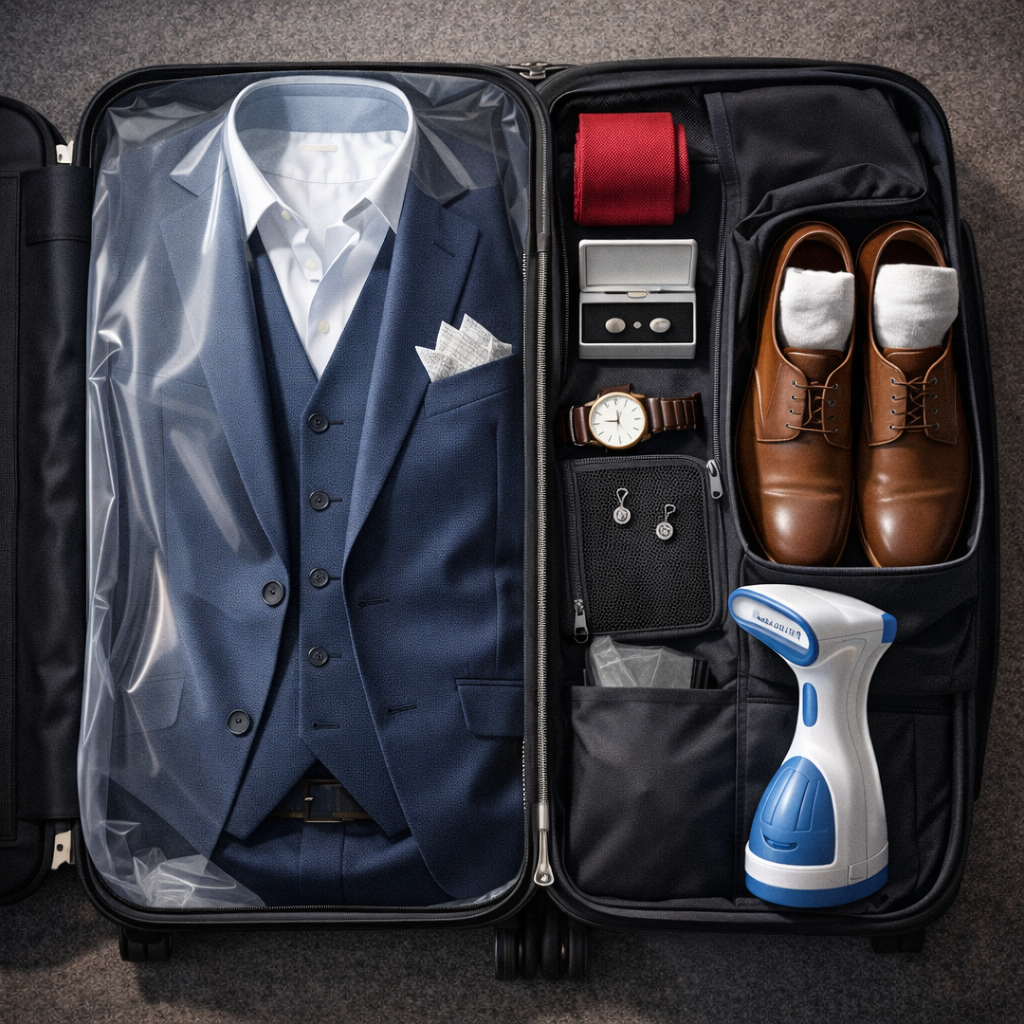
When planning formal travel, many people ask How to pack a suit in a carry-on without wrinkles when a wedding outfit includes extra pieces. A wedding ensemble adds more complexity because you may need to pack a waistcoat, dress shirt, pocket square, tie, and sometimes morning dress or a three-piece suit. To handle this properly, pack each item separately inside its own dry-cleaning bag to reduce friction and creasing.
If you want to master How to pack a suit in a carry-on without wrinkles, roll the tie loosely around a toilet paper roll core instead of folding it, especially for silk ties. Next, place dress shoes inside a shoe bag and stuff them with socks to help maintain their shape. For elaborate wedding attire, consider shipping the suit directly to the venue hotel through a courier service. This removes carry-on risk entirely and keeps your outfit in better condition.
Frequent Business Travelers: Building a Wrinkle-Resistant Wardrobe
If you’re on a plane every week, invest in suits designed specifically for travel:
- Bladen Travel Suit: British-made, machine washable, holds its shape exceptionally
- Suitsupply Jort: Unstructured, relaxed fit, wool-blend; recovers from packing without steaming
- M.M. LaFleur Bennett: Designed for women, travel-ready construction
- Indochino Performance Series: Made-to-measure with wrinkle-resistant fabric as standard
Combine travel-specific suits with a dedicated garment carry-on and a compact steamer, and wrinkles stop being a variable you manage — they become a problem you’ve eliminated.
FAQs
Can you fit a suit in a carry-on bag? Yes — with a carry-on of at least 40L and the right folding method, a two-piece suit packs neatly alongside two days of clothing and personal items. A three-piece suit or morning dress requires more space and planning.
What is the best way to fold a suit jacket for travel? The inside-out shoulder fold is the most widely recommended method for structured jackets — it protects the padding and lapels by nesting the shoulders together rather than flattening them.
Should I roll or fold my suit trousers? Fold along the natural crease line first, then gently roll from the hem upward. This follows the existing press line and minimises new creases forming across the knee or thigh.
How do I get wrinkles out of a suit quickly at a hotel? Hang the suit in the bathroom and run a hot shower for 10–15 minutes with the door closed. Steam relaxes the fibres and gravity does the rest. A travel steamer is faster and more reliable if you have one.
Is a travel suit garment bag worth it? For anyone travelling with a suit more than three or four times a year, yes. A good garment bag reduces handling stress, maintains the fold at the correct point on the jacket, and keeps the suit clean and isolated from other packed items.
What suit fabric wrinkles the least when packed? Wool-polyester blends and merino wool are the most forgiving travel fabrics. Pure linen, raw cotton, and open-weave unlined suits crease most severely and are the hardest to recover without professional pressing.