
Introduction to Mechanical Keyboard Guide
In today’s digital era, the keyboard is one of the most frequently used input devices. Whether you are a gamer, programmer, writer, or office worker, your keyboard directly affects your efficiency, comfort, and overall experience. While membrane keyboards dominate the budget market, mechanical keyboards have carved out a strong reputation for their performance, durability, and premium feel.
Mechanical keyboards are no longer just niche products for enthusiasts—they have become mainstream tools for productivity and gaming. With features such as customizable switches, RGB lighting, and modular components, they offer an unmatched level of personalization.
In this mechanical keyboard guide, we will explore their features in detail and help you understand why they are preferred over traditional keyboards. This mechanical keyboard guide will also cover essential topics such as switch types, keyboard sizes, customization options, and buying tips.
In this complete mechanical keyboard guide, you will learn everything about mechanical keyboards, including how they work, different switch types, available layouts, and how to choose the best option for your needs. This mechanical keyboard guide is designed for beginners as well as professionals who want to improve their typing and gaming experience.
You will also find practical insights on keyboard switches, gaming keyboards, and typing performance, making this guide useful for anyone looking to upgrade their setup.
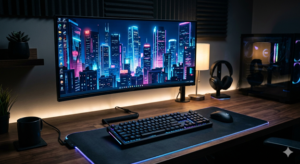
What Is a Mechanical Keyboard?
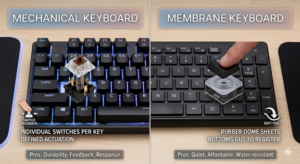
A mechanical keyboard is a type of keyboard that uses individual mechanical switches beneath each key. Unlike membrane keyboards, which rely on a rubber dome sheet, mechanical keyboards use physical switches made of components such as springs, stems, and metal contacts.
In this mechanical keyboard guide, it is important to understand that each key has its own independent switch. This allows every keystroke to be registered through a precise actuation point, resulting in a more accurate and responsive typing experience.
Each press delivers consistent feedback, which is one of the main reasons why mechanical keyboards are preferred in both gaming keyboards and professional typing setups. This makes them a popular choice for users who want durability, speed, and better control.
Overall, mechanical keyboards offer a premium typing experience that stands out from traditional keyboards, making them a key topic in any complete mechanical keyboard guide.
History of Mechanical Keyboards
The history of mechanical keyboards dates back to early computing systems and traditional typewriters. These early devices relied on mechanical switches that provided strong tactile feedback and high durability, forming the foundation of modern keyboard design.
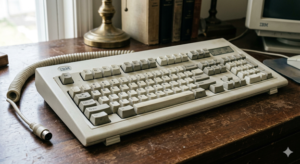
In the 1980s and 1990s, iconic keyboards such as the IBM Model M became widely popular for their robust build quality and reliable mechanical switch system. These keyboards were considered the standard for performance and longevity, and they played an important role in shaping modern input devices.
In this mechanical keyboard guide, it is important to understand that as computers became more affordable, manufacturers gradually shifted toward membrane keyboards to reduce production costs. While this made keyboards cheaper, it reduced the tactile experience and durability that mechanical switches offered.
However, in recent years, mechanical keyboards have made a strong comeback. Due to increasing demand from gamers, programmers, and typing enthusiasts, mechanical switches are once again widely used in modern gaming keyboards and productivity setups. This resurgence has made them a key topic in any complete mechanical keyboard guide.
How Mechanical Keyboards Work
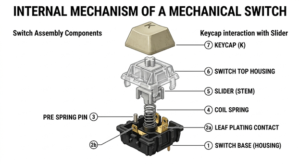
In this mechanical keyboard guide, it is important to understand how mechanical keyboards actually work at a physical level. Each key on a mechanical keyboard contains an individual switch that operates independently, which is the main reason for its precision and durability.
When a key is pressed, the mechanism works in a sequence. First, the stem moves downward. Then the spring inside the switch compresses. After that, the metal contacts inside the switch touch each other, completing the circuit. Finally, a signal is sent to the computer, registering the keystroke instantly.
This simple but highly efficient mechanism ensures fast, accurate, and consistent input, which is why mechanical keyboards are widely used in gaming and professional typing setups. Compared to membrane keyboards, this design offers much better responsiveness and reliability, making it an essential topic in any mechanical keyboard guide.
Types of Mechanical Switches
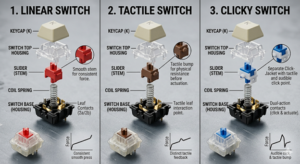
Linear Switches
Linear switches provide a smooth keystroke without any tactile bump or click. They are fast and quiet, making them ideal for gaming.
Tactile Switches
These switches have a noticeable bump that indicates actuation. They are perfect for typing and general use.
Clicky Switches
Clicky switches produce an audible click sound along with tactile feedback. They are satisfying but can be noisy.
Popular Switch Brands
Some well-known switch manufacturers include:
- Cherry MX
- Gateron
- Kailh
- Razer
Each brand offers different variations in feel, sound, and performance.
Keyboard Sizes and Layouts
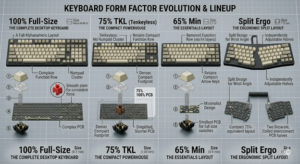
Full-size (100%)
Includes all keys, including numpad
TKL (Tenkeyless)
Compact without a numpad
60% Keyboard
Minimal layout
65% and 75%
Balanced layouts
Advantages of Mechanical Keyboards
Durability
Mechanical switches last up to 100 million keystrokes.
Typing Experience
Better feedback improves accuracy and speed.
Customization
Users can change switches, keycaps, and lighting.
Gaming Performance
Faster response time and advanced features.
Disadvantages
- Expensive
- Noisy (depending on the switch)
- Heavier
RGB Lighting and Aesthetics in Mechanical Keyboards
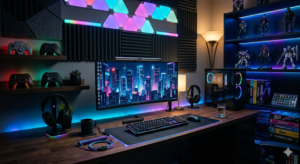
RGB lighting allows users to customize colors and effects. It enhances both visual appeal and usability.
Custom Mechanical Keyboards
Custom keyboards allow complete personalization.
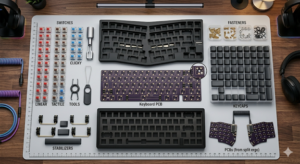
Components:
-
PCB
-
Plate
-
Case
-
Switches
-
Keycaps
Keycaps: Materials and Profiles
Materials
-
ABS
-
PBT
Profiles
-
OEM
-
Cherry
-
SA
Hot-Swappable Keyboards
These keyboards allow switch replacement without soldering, making them beginner-friendly.
Wired vs Wireless Keyboards
Wired
- Lower latency
- Reliable connection
Wireless
- Cleaner setup
- Portable
How to Choose the Right Mechanical Keyboard
-
Purpose
Gaming, typing, or office
-
Switch Type
Choose based on preference
-
Budget
-
Build Quality
Best Budget vs Premium Keyboards
Budget
- Affordable
- Basic features
Premium
- High-quality materials
- Advanced features
Maintenance and Cleaning
- Remove keycaps
- Clean dust
- Use compressed air
- Reassemble
Common Mistakes to Avoid When Buying a Mechanical Keyboard
- Buying without testing switches
- Ignoring layout
- Overspending on RGB only
Who Should Use Mechanical Keyboards
- Gamers
- Programmers
- Writers
- Professionals
Future Trends in Mechanical Keyboards
- Wireless technology
- Silent switches
- Low-profile keyboards
- Custom ecosystems
Conclusion
Mechanical keyboards are more than just tools—they are an experience. With their superior performance, durability, and customization options, they are an excellent investment for anyone who spends significant time on a computer.
By understanding switches, layouts, and features, you can find the perfect keyboard that matches your needs and enhances your productivity.
Mechanical Keyboard Guide FAQ
1. Why should I follow a mechanical keyboard guide before buying?
Answer: Following a guide helps you understand switch types and layouts, ensuring you get the best value for your money.
2. Which switch is best for beginners?
Answer: Tactile switches are recommended.
3. Which switch is best for gaming?
Answer: Linear switches are best.
4. Are they noisy?
Answer: Some are, but silent options exist.
5. Is RGB necessary?
Answer: No, but it improves aesthetics.
6. How much do they cost?
Answer: $30 to $300+.
7. How long do they last?
Answer: 5–10 years or more.
8. Is building a custom keyboard hard?
Answer: It takes practice, but it is manageable.